


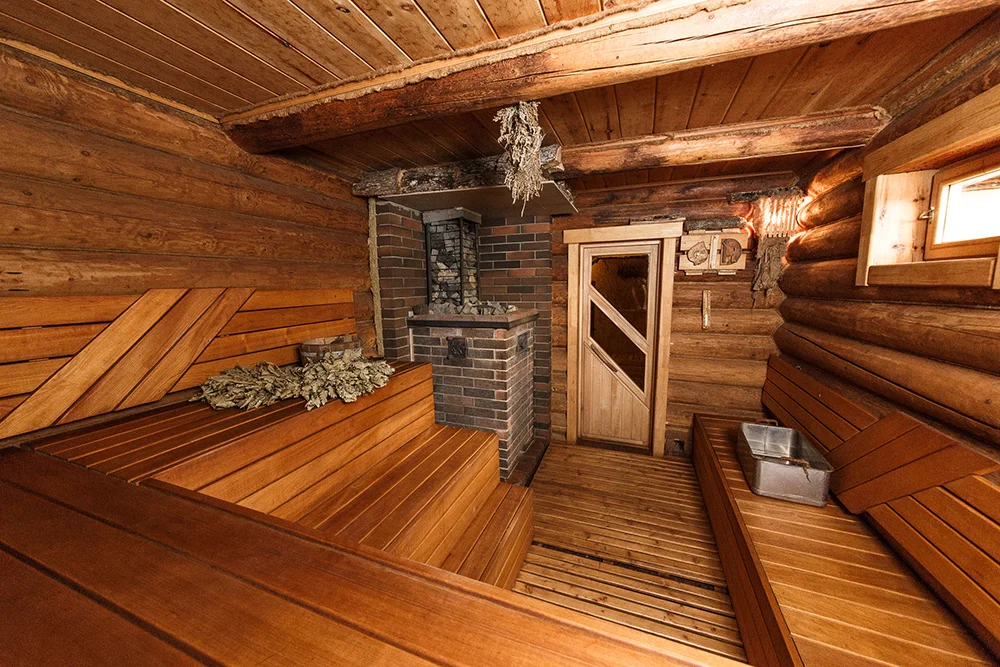
The Russian banya (sauna) is one of the world’s most well-known sauna traditions. The Russian sauna has not been merely a place for washing; it was also an important site where people were traditionally treated for ailments and where childbirths often took place. In the sauna, young women would sometimes predict their future husbands, and village healers frequently performed rituals and healing procedures there.
In the past, it was believed that the sauna united the four elements – air, earth, water, and fire. Warming up on the sauna bench was thought to heal not only the body but also the spirit. The sauna belonged to almost every farmstead that could afford it. From the 17th century onwards, public saunas began to appear, which anyone could visit for a small fee.
The first saunas were smoke saunas, without a chimney, so smoke and soot escaped through the cracks and openings of the room. These saunas were typically heated with birch, alder, or other types of wood. Over time, the walls and ceiling darkened from soot. This type of sauna became known as the “black sauna.” Smoke saunas were more hygienic, as the high temperature and smoke helped destroy bacteria.
Later, chimneys were added so that smoke no longer filled the room, keeping the walls clean. These saunas became known as “white saunas.” Today, smoke saunas are rare in Russia but still exist, particularly in Karelia, Siberia, and older villages.
A traditional Russian banya consists of three parts: a changing room, a washing room, and a steam room.
The temperature in a Russian sauna is usually 60–80 °C, with humidity around 40–70%, making it one of the more humid types of saunas. The humidity is created by throwing water onto the hot stones.
Traditional medicine and modern physiotherapy recognize the beneficial effects of hot steam on muscles, the respiratory system, and circulation. In the past, herbs and tinctures were often used in the sauna to enhance the healing effect.
In addition to its benefits for the body, the sauna also provides rest for the mind. In a genuine sauna, listening to the crackle of burning wood and inhaling the fragrant steam of herbs, one can relax and reflect on life and existence. This has been the case for centuries, and it remains so today.

